Antweight vs beetleweight: which weight class to choose for your first combat robot
Antweight (150 g) and beetleweight (1.5 kg) compared under the CCRL rules: size, voltage, weapon energy, build cost and safety. Where to start and why.
Short answer: start with antweight. A robot under 150 g is built from parts costing about a thousand crowns (€41), prints on any desktop printer, and losing a motor in your first fight costs 99 CZK. Beetleweight (up to 1.5 kg) is a full mechanical engineering project with metal, bigger motors and a weapon-energy calculation – a great second step, not a first one. Both classes run under the Czech Combat Robot League (CCRL) rules and differ mainly in the numbers below.
What the rules say: the key limits
The table summarises the most important points of the official antweight and beetleweight rules. Always read the current wording before a tournament – the values below apply to the 2026 season.
| Parameter | Antweight | Beetleweight |
|---|---|---|
| Maximum weight | 150 g | 1.5 kg |
| Non-traditional movement (no wheels, tracks or rollers) | 225 g | 2.25 kg |
| Walking robots (legs with ≥ 2 degrees of freedom) | 300 g | 3 kg |
| Size | 15 × 15 cm square, no height limit | no limit, must fit in the arena |
| Maximum voltage | 24 V | 50 V |
| Spinning weapon energy | no limit | max. 1 kJ, proven with the Bristol Bot Builders calculator |
| Pneumatics / hydraulics | 7 bar / 15 bar | 10 bar / 100 bar |
| Tethered weapon | up to 50 cm from the robot’s centre | up to 1 m |
| Power indicator light | not required | mandatory, wired directly to the battery |
| Clusterbots (multi-part robots) | yes, weights added together | yes, weights added together |
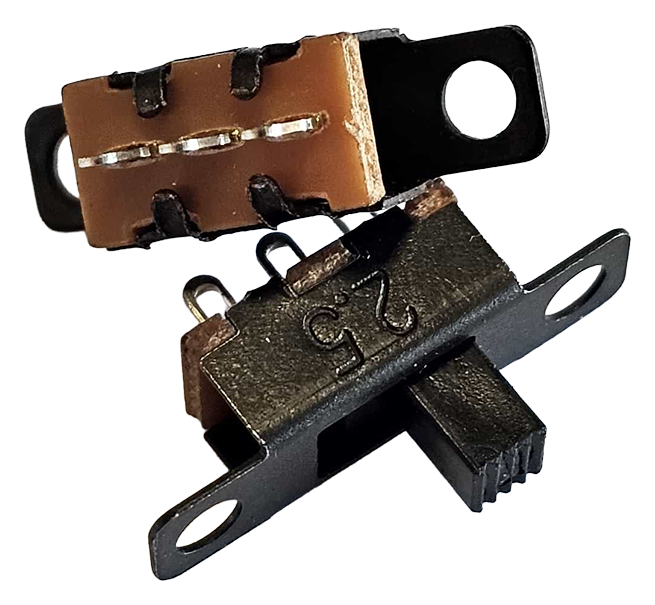
Shared by both classes: a failsafe that stops drive and weapon when the signal is lost (rule 5.1), a switch reachable from outside (5.2), a physical lock on any dangerous weapon outside the arena (5.3), fights only in the arena with the doors closed (5.4) and supervised battery charging next to a fireproof container (3.3). Banned are liquid-spraying weapons, nets and glue, electronic jammers, magnets, explosives, untethered projectiles, fire and blinding lights (4.1).
Antweight: where to start
Antweight is the entry class for several connected reasons:
- Cost. A complete pusher costs 900–1,200 CZK; the transmitter and charging kit are bought once. The full breakdown is in How much does it cost to build a combat robot.
- Manufacturing. The body fits any desktop printer and prints in an hour or two. Iterations are cheap – if an idea fails, you print version two tomorrow.
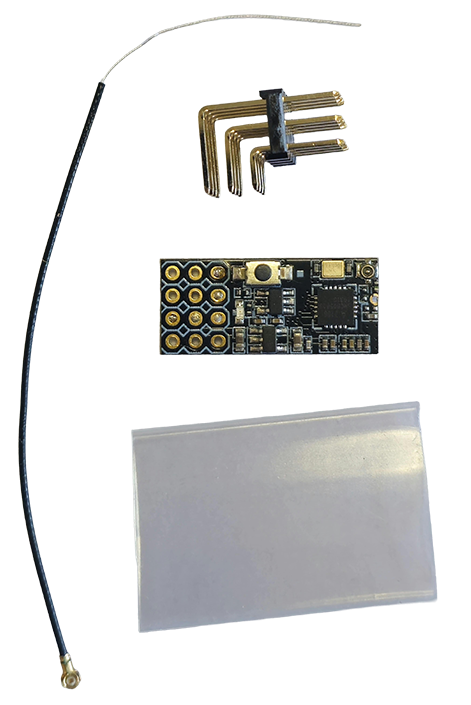
- Parts from one place. N20 motors, ESCs, receivers, wheels and antweight weapons are in stock in our e-shop.
- Safety. Even an antweight spinner is manageable in a test box; a beetleweight weapon carries enough energy to punch through sheet metal.
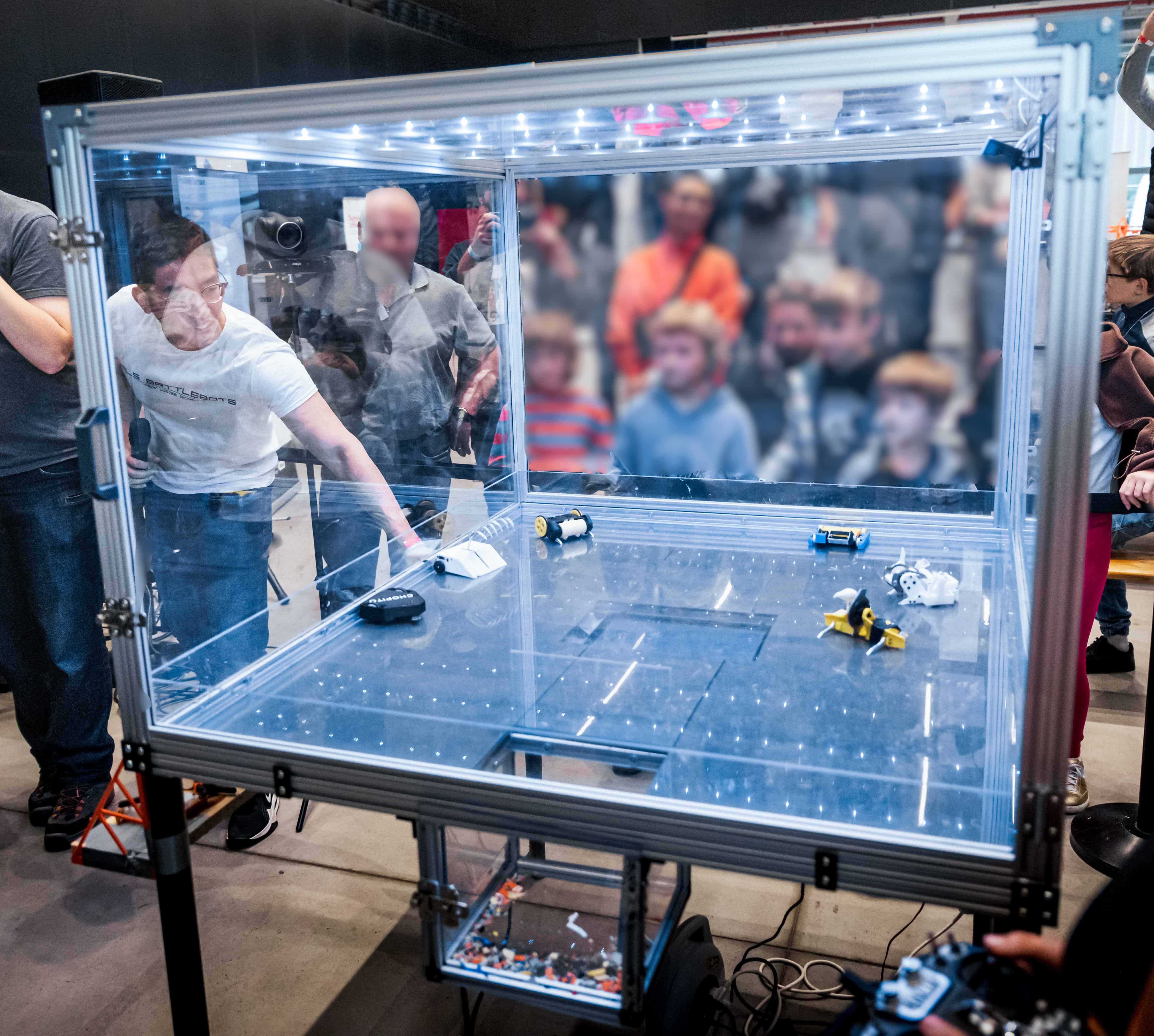
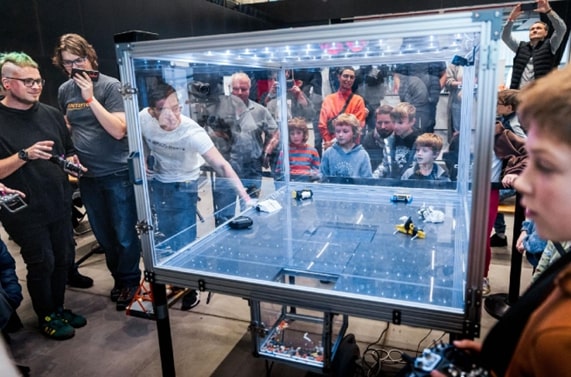
- Where to compete. Czech Combat Robot League tournaments run antweight all over the country – see Tournaments.
A typical first build: two N20 motors (600–1,000 rpm), a dual ESC, an FS2A receiver, a 2S LiPo of 300–450 mAh and a PETG wedge. It lands at 120–140 g, leaving a reserve for armour or a servo. The step-by-step guide is How to build a combat robot.
Beetleweight: when you want more
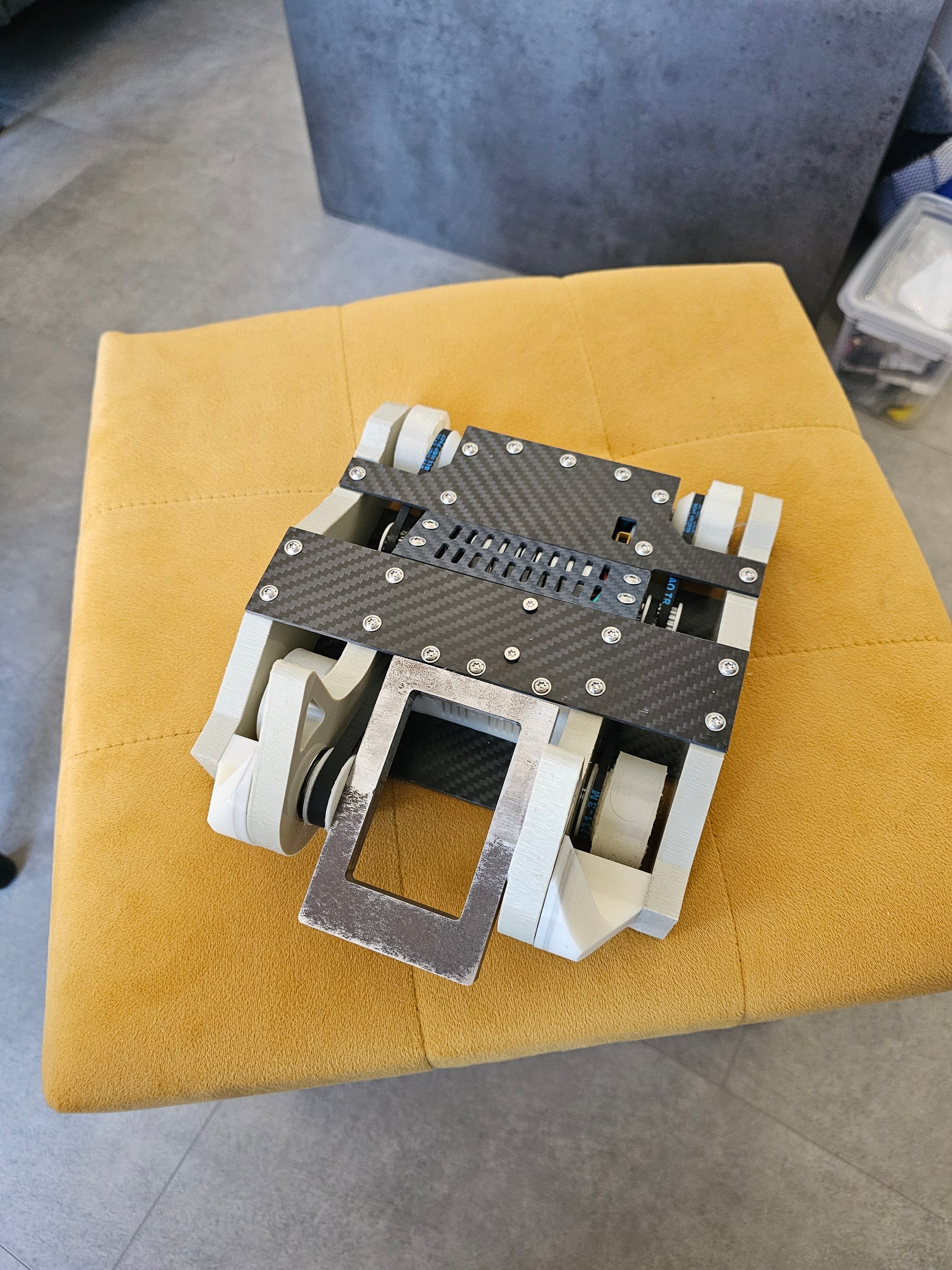
Ten times the weight changes everything:
- Materials. Plastic no longer works for the weapon or the front. Builders use steel, aluminium, UHMW and TPU as a damper.
- Drive. Motors of 22 mm and up, often brushless with a gearbox, 3S–4S batteries and ESCs rated in tens of amps.
- A weapon with an energy cap. A spinning weapon may store at most 1 kJ. You need the disc’s moment of inertia (from CAD) and the motor speed, and you bring the Bristol Bot Builders calculator result to the check.
- A stricter check. A mandatory power light wired straight to the battery, drive testing only on a stand, weapon locked before every power-up.
- Logistics. A robot with spares and tools is a crate, not a box. Post-fight damage is more serious and more expensive.
Budgets start at 5,000 CZK (€200) and a spinner easily exceeds 10,000 CZK. The class overview is on the Beetleweight page.
Exceptions: non-traditional movement and walkers
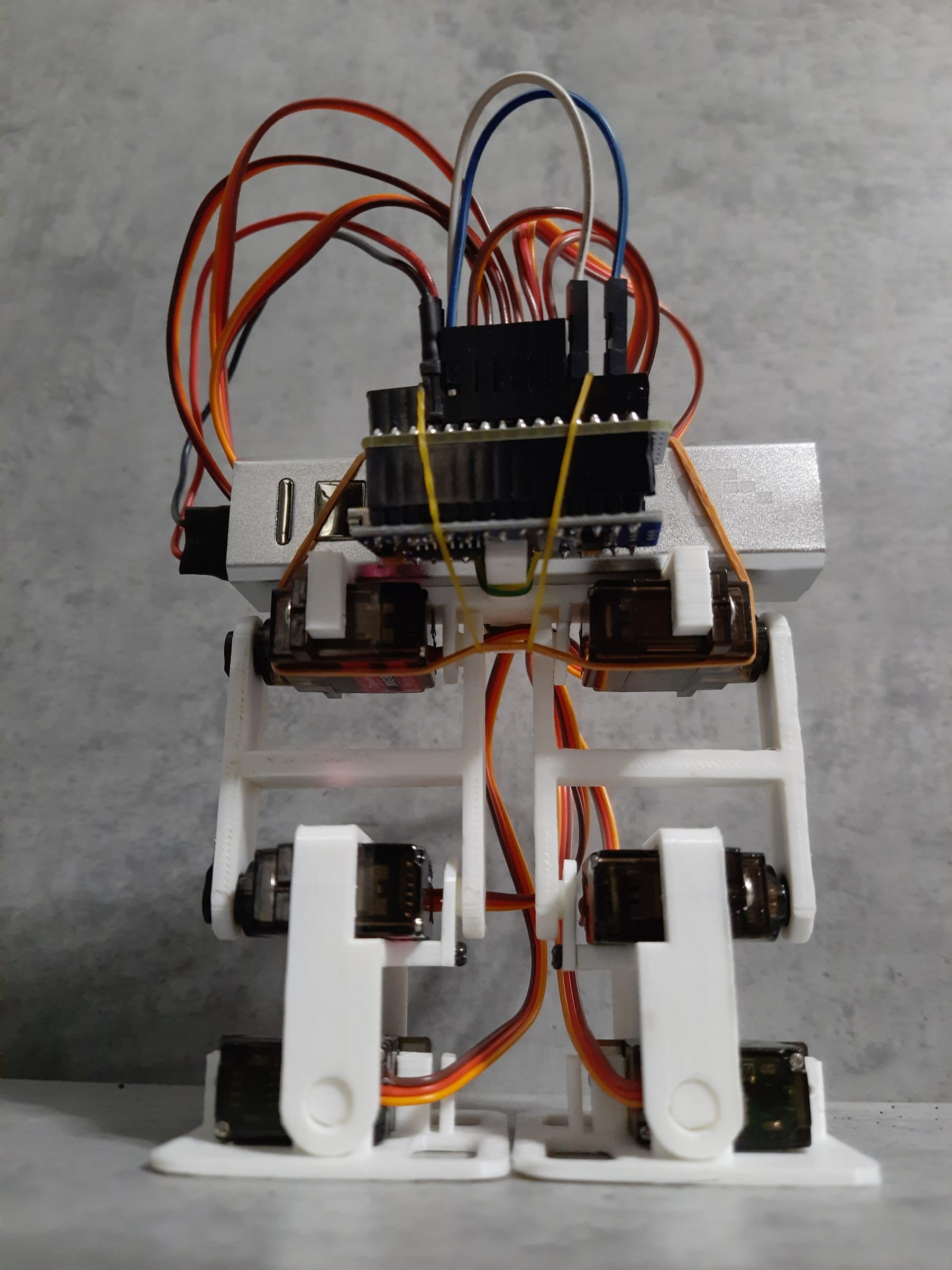
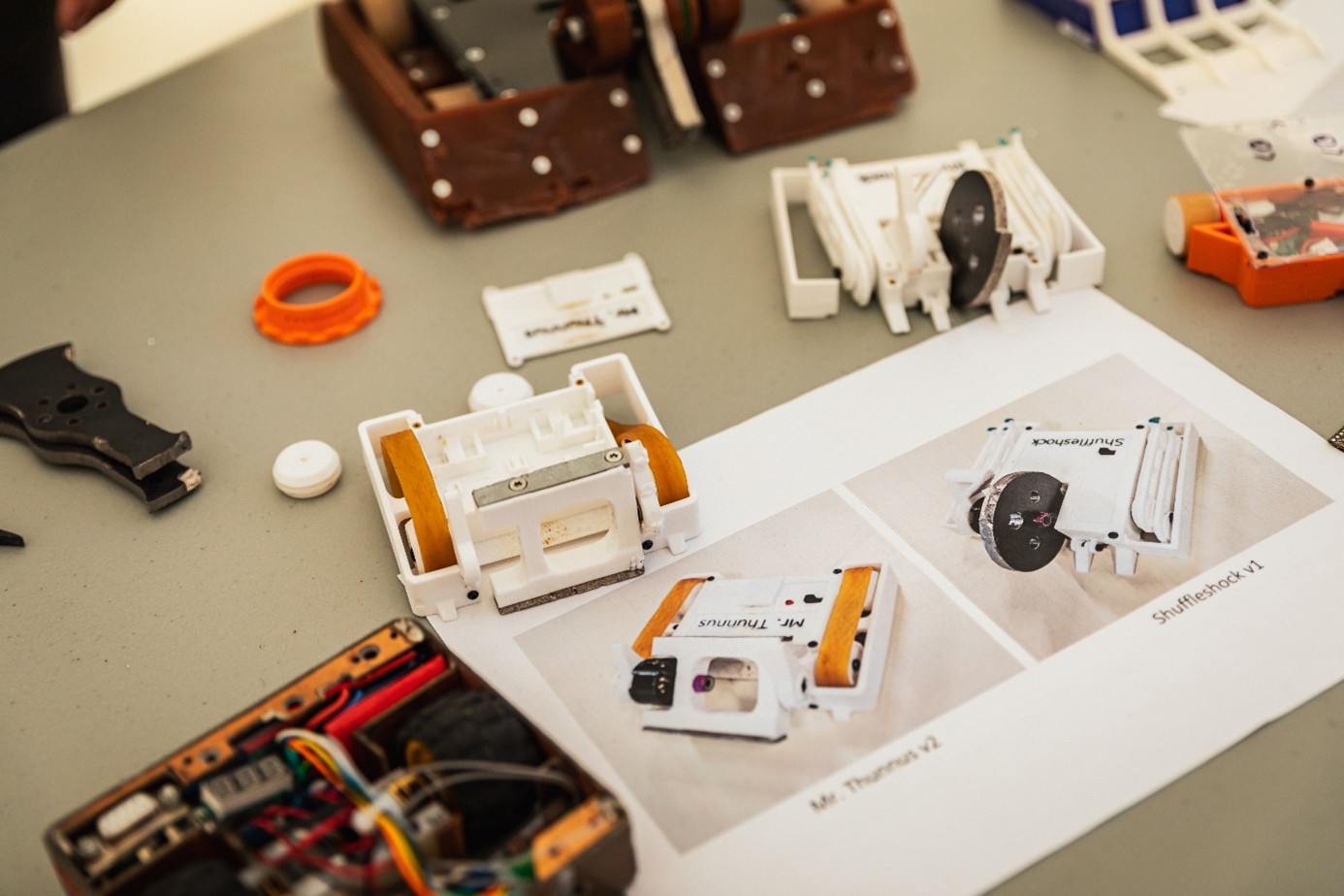
The rules reward robots that do not move on wheels or tracks. A robot with non-traditional movement (shufflers, vibration drives and similar) may weigh half as much again: 225 g in antweight and 2.25 kg in beetleweight. Walking robots whose legs have at least two degrees of freedom get double the limit: 300 g and 3 kg respectively. The bonus also applies to clusterbots, where the weight is split according to a formula in the rules. What counts as which kind of movement is explained on the Traditional movement, Non-traditional movement and True walking movement pages.
For a beginner this is a curiosity: a non-traditional chassis is harder to design than wheels and the bonus weight rarely makes up for it. For experienced builders it is the most open field for originality.
Safety is the same in both classes
Whatever you choose, the tech check verifies the same things: weight and size, a working switch with marked positions, failsafe (turn the transmitter off – the robot must stop immediately) and the weapon lock. Prepare at home:
- Weigh the robot with the battery in its heaviest configuration.
- Switch the transmitter off with the drive and weapon running and confirm everything stops within a second.
- Check that the switch can be operated without opening the robot.
- For a spinner, print or make a lock that completely immobilises the weapon.
- Pack the batteries in a LiPo safety bag.
How to decide: five questions
- Do you already have experience with RC models or electronics? No → antweight.
- Do you want to compete this year? Yes → antweight, it is done in a few weekends.
- Do you have access to metalworking or a workshop? No → antweight; beetleweight does not work without metal.
- How much do you want to invest? Up to 3,000 CZK → antweight. Over 5,000 CZK and you enjoy the engineering → beetleweight.
- Is the weapon what excites you most? Try a spinner in antweight first – the physics is the same, the consequences smaller.
Raptorweight and featherweight are even bigger machines; they are not our main programme yet, but the site has an overview of each.
Whatever you pick, at our workshops we build antweight robots with participants from scratch and are happy to advise on a beetleweight design too.
Frequently asked questions
Can an antweight robot weigh less than 150 g?
Yes, the limit is a maximum. A lighter robot simply gives away mass it could have spent on armour or the weapon – every good build aims for 148–150 g in fighting configuration, battery included.
What happens if the robot weighs 152 g at the tech check?
It fails the check and cannot enter the arena. The rules allow interchangeable panels and weapons, so bring a lighter wedge or weapon variant, and you will usually find a few grams in surplus screws.
Can I enter the same robot in both classes?
No, the weight differs tenfold. What you can share between classes is the transmitter, charger, tools and, above all, driving experience.
What battery voltage is used?
Antweight typically runs on 2S LiPo (7.4 V) with a rules limit of 24 V. Beetleweight uses 3S–4S LiPo (11.1–14.8 V) with a 50 V limit. Battery selection is covered in LiPo batteries for combat robots.
How is the weapon energy calculated in beetleweight?
As the kinetic energy of a rotating body (½ · I · ω²). The CCRL rules require the Bristol Bot Builders calculator, and the result must be shown on paper or on a screen at the tech check; the moment of inertia comes from your CAD program.
How do I weigh the robot at home?
For antweight a kitchen scale with 1 g resolution is enough. Weigh the complete robot – battery, weapon and all panels – in exactly the configuration that goes to the check.