How much does it cost to build a combat robot? An antweight budget, item by item (2026)
Antweight combat robot budget line by line: motors, ESC, receiver, battery and 3D printing. A basic pusher costs about 1,000 CZK (€41), a spinner from 2,000 CZK.
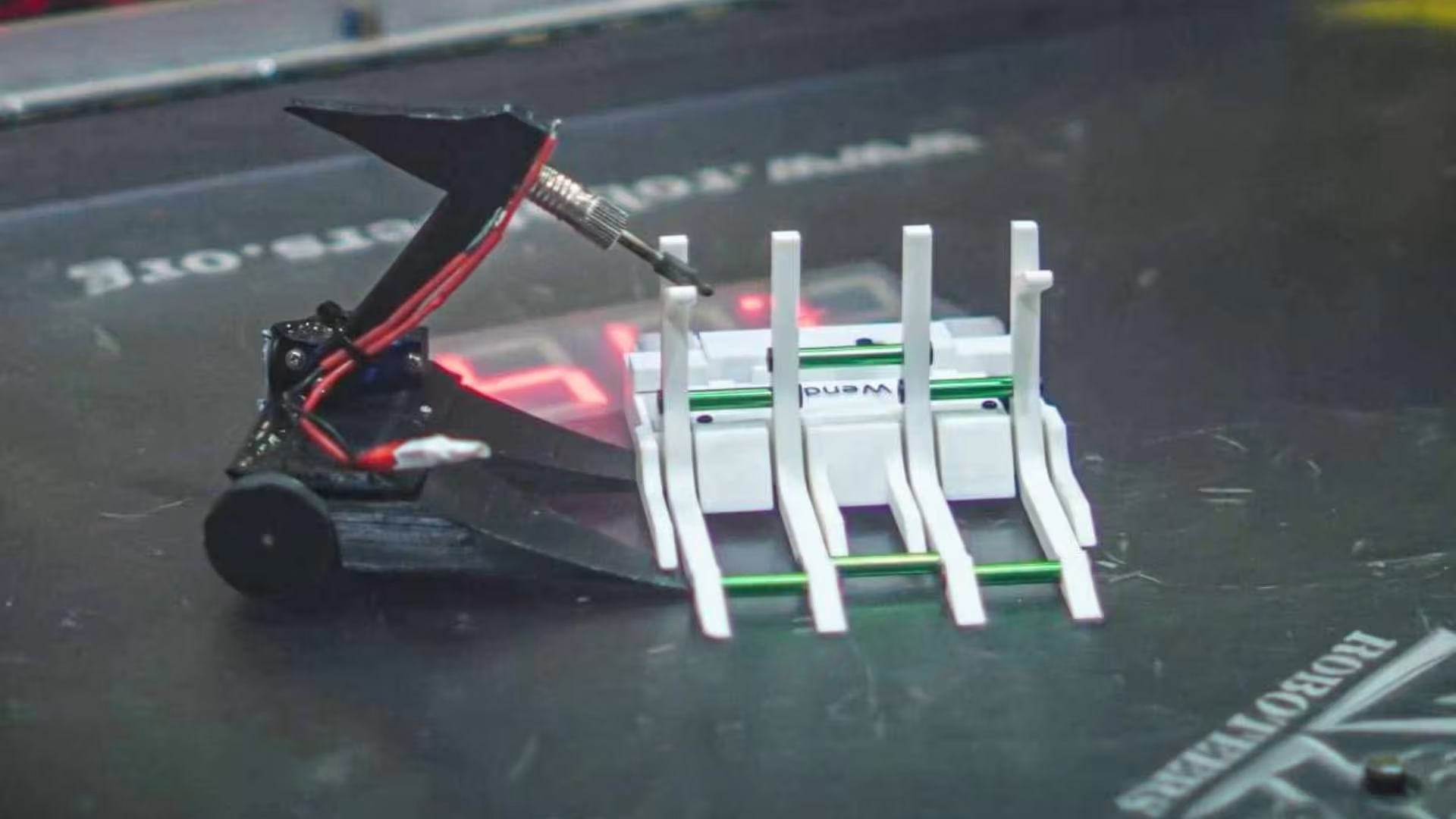
Short answer: a basic antweight robot (up to 150 g) without an active weapon costs 900–1,200 CZK (€37–49) in parts. With a spinning weapon budget 2,000–2,500 CZK (€82–103). On top of that you buy a transmitter (1,299 CZK) and a charging kit (about 300 CZK) once – both serve every robot you build afterwards. Prices are from our e-shop as of September 2026; 1,000 CZK is roughly €41.
What a combat robot needs
Before adding things up, look at what an antweight robot consists of. Every line in the budget maps to one function:
- Drive – two gear motors and wheels. The antweight standard is the N20 motor, or the smaller and stronger N10.
- Control – a receiver that listens to the transmitter and an electronic speed controller (ESC) that feeds current to the motors accordingly.
- Power – a 2S LiPo battery, a switch reachable from outside and wiring with connectors.
- Body – usually 3D printed in PETG or PLA; TPU or aluminium on more advanced machines.
- Weapon – optional: a wedge, a servo-driven lifter or a spinner with a brushless motor.
- Transmitter – one for all your robots.
How these parts talk to each other is explained in the tutorial How a combat robot works.
Budget for a basic antweight robot
This is the set-up most people start with at our workshops: a two-motor robot with a wedge and no active weapon. It fits the rules, can be built over a weekend and has nothing to lose in the arena.
| Item | Qty | Price | Note |
|---|---|---|---|
| N20 DC motor with gearbox | 2 | 198 CZK | 99 CZK each; the N10 at 189 CZK is smaller and more powerful |
| Dual speed controller 5 A | 1 | 199 CZK | drives both motors, supports braking |
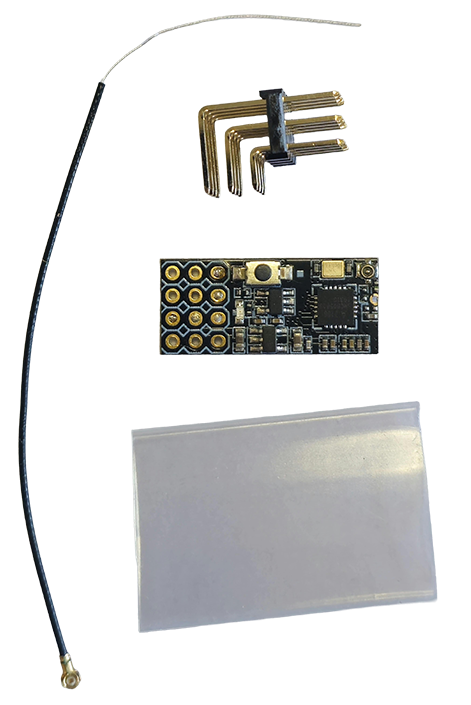
| Flysky FS2A receiver | 1 | 249 CZK | 4 channels, failsafe as required by rule 5.1 |
| Wheels for N20 | 2 packs | 50 CZK | four wheels; a two-wheeler needs one pack at 25 CZK |
| Slide switch SS12F15VG4 | 1 | 9 CZK | externally reachable switch (rule 5.2) |
| JST PH 2.0 connectors + silicone wire | – | 30 CZK | 5 connector pairs 18 CZK, 26 AWG wire 6 CZK |
| Screws, threaded inserts, motor mounts | – | 60 CZK | N10/N20 mount 19 CZK, inserts 8–12 CZK per 5 |
| 2S LiPo battery 300–450 mAh | 1 | 150–250 CZK | not in our shop; any RC hobby store |
| Filament for the body (40–60 g PETG) | – | 30 CZK | print at home, at school or via a print service |
| Total | ≈ 980–1,080 CZK (€40–45) | without transmitter and charging kit |
A few notes on the choices:
- N20 vs. N10. The N20 is cheaper and more robust; the N10 saves space and weight you can spend on armour or a weapon. For a first robot we recommend the N20 at 600–1,000 rpm – faster gearing is harder to drive.
- ESC. The dual 5 A controller handles both drive motors and the short overloads of pushing an opponent. Single-motor 3 A controllers at 99 CZK only make sense for special layouts.
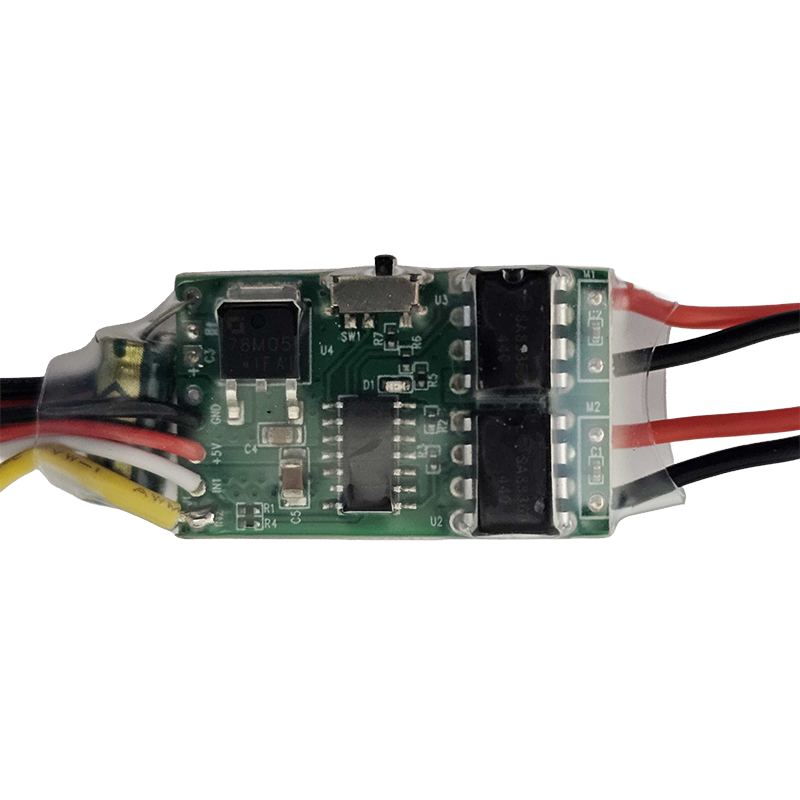
- Malenki Nano HV. A receiver and dual ESC in one module at 849 CZK replaces items 2 and 3 (448 CZK together). It costs 400 CZK more but saves four cables and space in the chassis – worth it on robots where every gram counts.
One-off equipment: transmitter and charging
These you buy once and use with every robot you ever build:
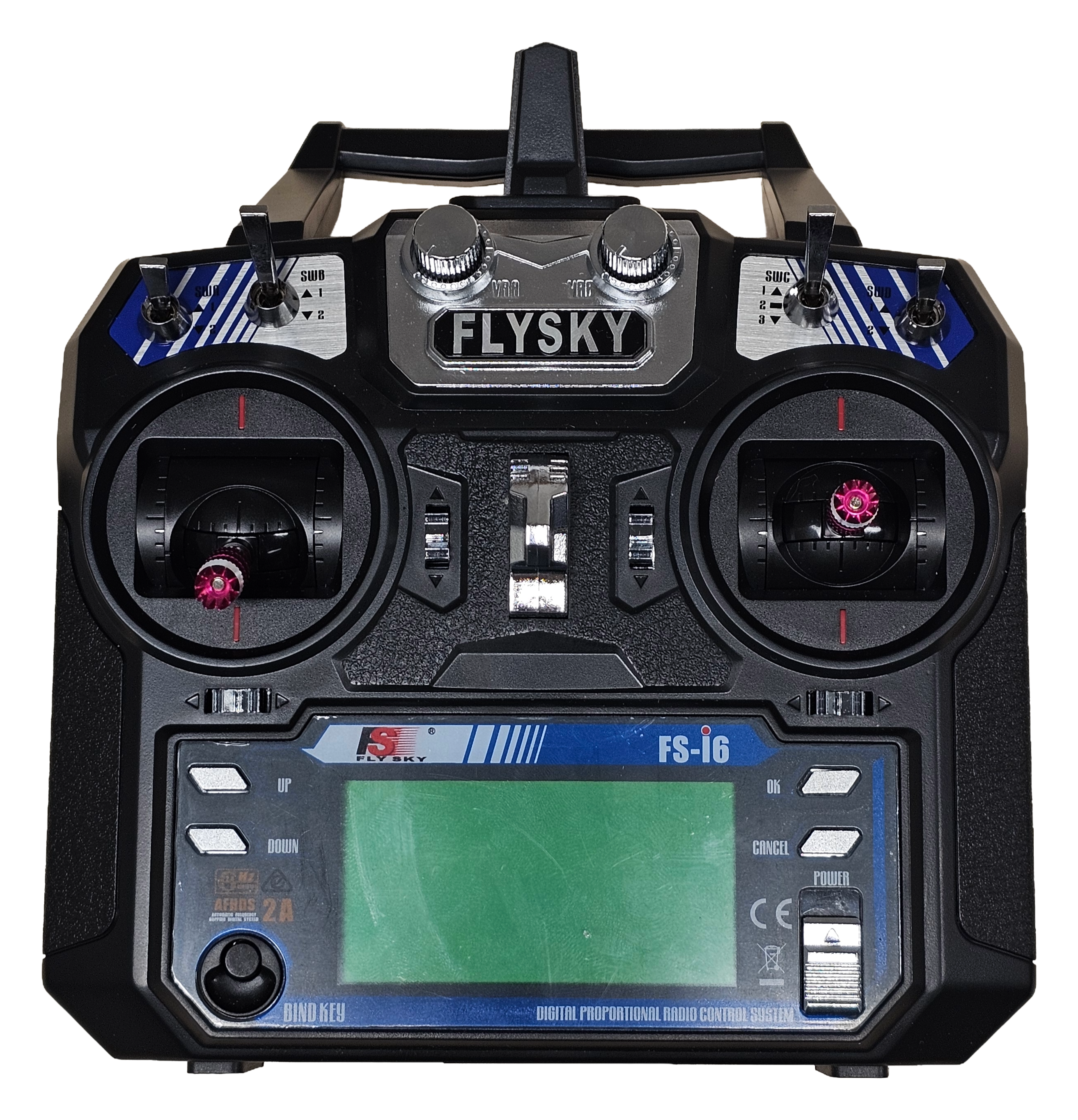
- Flysky FS-i6 radio transmitter – 1,299 CZK. Six channels, memory for 20 models, pairs with FS2A receivers.
- 2S LiPo charger – 79 CZK.
- LiPo battery tester – 69 CZK. Shows the voltage of each cell, so you spot a flat or damaged pack before the robot dies mid-fight.
- LiPo safety bag – 149 CZK. Rule 3.3 of the CCRL rules requires supervised charging next to a fireproof container; without one you will not be allowed to charge at a tournament.
About 1,600 CZK (€66) in total. The entry ticket for a first robot including the radio and charging therefore comes to 2,500–2,700 CZK (€103–111); the second robot costs only the thousand or so.
What a weapon costs
Spinner
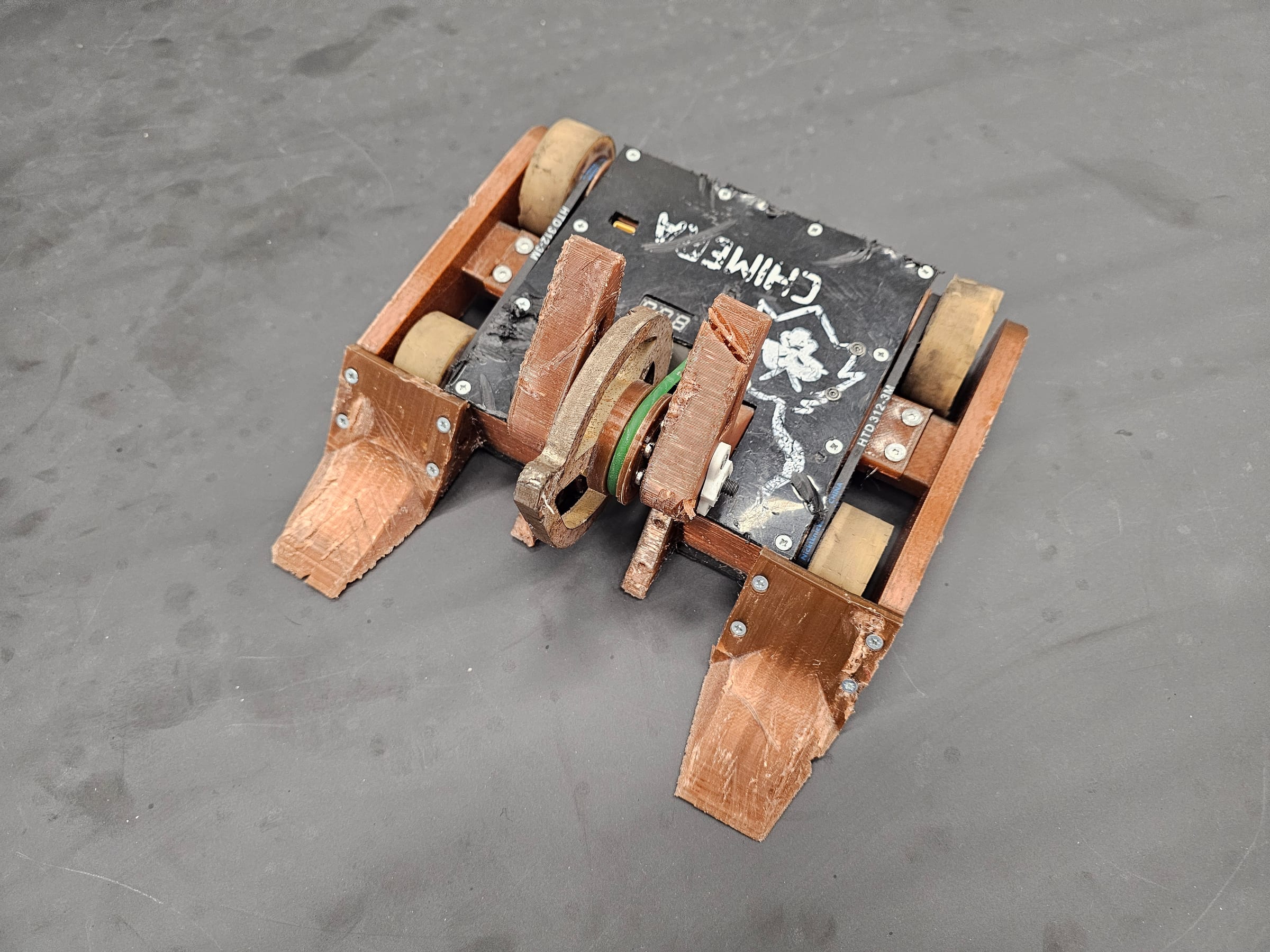
A spinner is the most spectacular and the most expensive route. You need a fast brushless motor, an ESC for brushless motors and the blade or disc itself:
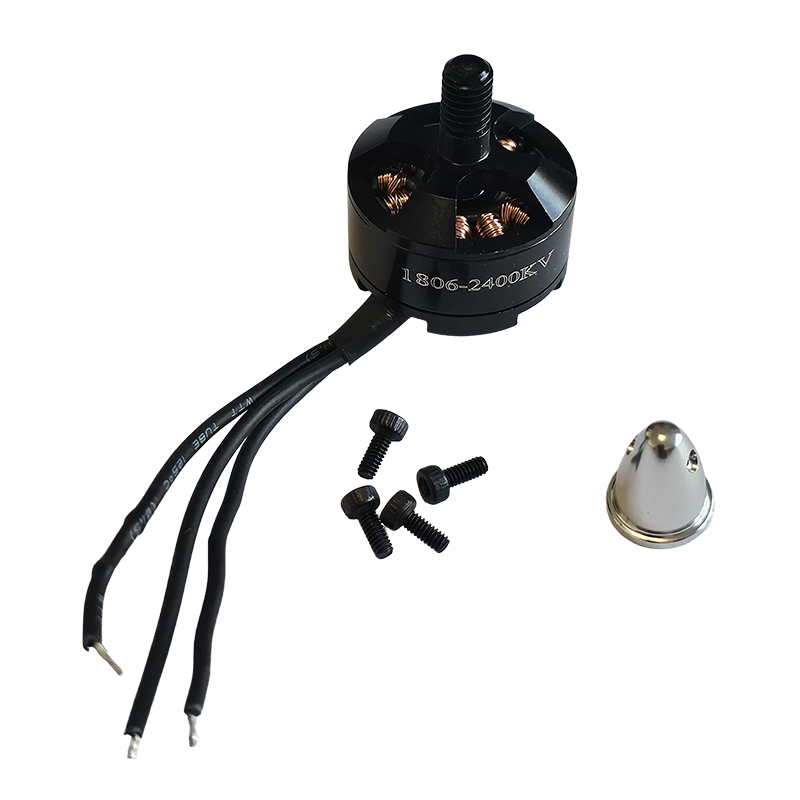
- Brushless motor 1806 2400KV – 249 CZK
- 20 A brushless ESC – 199 CZK (for heavier discs the AM32 40 A at 349 CZK)
- Blade 48 mm – 219 CZK, blade 60 mm – 249 CZK; disc 48 mm – 349 CZK, disc 60 mm – 399 CZK
- Aluminium M5 lock nut – 15 CZK (CW or CCW depending on the spin direction)
That is 680–1,010 CZK extra. A spinner robot therefore lands at 1,700–2,100 CZK, and with a reserve for thicker walls and a spare blade plan on 2,000–2,500 CZK. How to design and balance a spinner is covered on the Spinner page.
Flipper, lifter and grabber
Lifting and grabbing weapons are servo-driven and an order of magnitude cheaper:
- SG90 servo with plastic gears – 59 CZK, for light flaps and claws
- MG90S servo with metal gears – 79 CZK, survives impacts and prying
- Powerful PTK servo for 8.4 V – 269 CZK, runs straight from a 2S battery without a regulator
The SG90 and MG90S need 5 V, so add an adjustable BEC at 29 CZK. 100–300 CZK on top. The pros and cons of each weapon are compared on the Weapon types page.
Where to save and where not to
Worth saving on
- Body. PETG or PLA from an ordinary printer is enough. First robots do not need TPU or aluminium – spend the weight on thicker walls around the electronics instead.
- Weapon. A wedge or pusher with no moving parts wins surprisingly often. Add the weapon in version two, once you can drive.
- Number of wheels. A two-wheeler with a skid at the back is cheaper, lighter and turns well.
- Phone control. An ESP32-C3 Super Mini board at 99 CZK replaces the transmitter and receiver (saving 1,548 CZK). The tutorial How to control a combat robot via mobile phone shows how. Great for practice and a first build; for tournaments we recommend a regular 2.4 GHz radio for signal reliability and failsafe.
Not worth saving on
- A receiver with failsafe. Without it you will not pass the tech check. Cheap marketplace receivers often lack it.
- Switch and connectors. Twisted wires and tape are the most common reason a robot suddenly dies in the arena. A JST connector costs 9 CZK for five.
- A spare motor. One extra N20 at 99 CZK saves your day when a shaft snaps in the first fight.
Running costs over a season
Once the robot works, you mostly pay for wear: motors (99 CZK), wheels (10–25 CZK per pack), a second battery so you do not have to worry about charge between fights, and some filament for spare parts. For a season with a few tournaments plan on 500–1,000 CZK (€20–41). We ship across Europe; rates for Germany, Austria, Poland, Slovakia and the rest of the EU are on the Shipping & payment page.
Beetleweight: an order of magnitude more
A beetleweight robot may weigh 1.5 kg, uses 22 mm and larger motors, 3S–4S batteries and steel or aluminium for the weapon. The rules cap the energy of a spinning weapon at 1 kJ, which for a good spinner means a motor and ESC costing thousands of crowns. A realistic budget is 5,000–10,000 CZK (€200–400) depending on the weapon. We compare both classes in Antweight vs beetleweight and the full rules are on the Beetleweight page.
The cheapest start: a workshop or camp
If you do not want to buy parts blind, come to one of our workshops – we build in Prague, Brno, Pilsen, České Budějovice and Karlovy Vary and you take the robot home. The price and what the kit includes are listed with each date. For kids we run a summer day camp in Pilsen.
Every part in this article is in stock in the e-shop and ships within 1–2 working days.
Frequently asked questions
Can you build a combat robot for under 1,000 CZK (€41)?
Yes, if you have access to a 3D printer and already own a transmitter. Two N20 motors (198 CZK), a dual 5 A ESC (199 CZK), an FS2A receiver (249 CZK), wheels, switch, connectors and a battery add up to roughly 950 CZK. Without your own transmitter you will not get under that figure – but the radio is bought only once.
Do I need my own 3D printer?
No. An antweight body weighs 40–60 g and a school, library, makerspace or print service will print it for a couple of euros. Settings and tips are in the tutorial How to print parts.
Can I use one transmitter for several robots?
Yes. The Flysky FS-i6 stores 20 models; each robot gets its own FS2A receiver (249 CZK) and you simply switch the model on the transmitter.
Is the Malenki Nano worth it instead of a separate receiver and ESC?
If you are fighting for every gram and millimetre, yes: the Malenki Nano HV is a receiver and dual ESC in one 849 CZK module and saves four cables. For a first build the FS2A + dual 5 A ESC combination at 448 CZK is cheaper.
How much does a beetleweight robot cost?
Roughly 5,000–10,000 CZK (€200–400): bigger motors, stronger ESCs, 3S–4S batteries and metal parts for the weapon and frame. Start with antweight – most of the knowledge, tools and the transmitter carry over.
Which spare parts should I buy right away?
At least one extra N20 motor (99 CZK), a pack of wheels and a few JST connectors. Motors and wheels are what breaks most often at a tournament, and without spares the robot is out after its first fight.